 TEXTILES.ORG




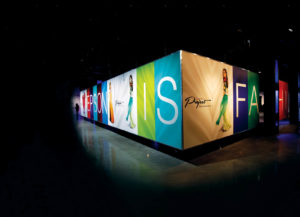
As applications respond, the digital fabric printing industry is responding to the technical and creative demands of customers.
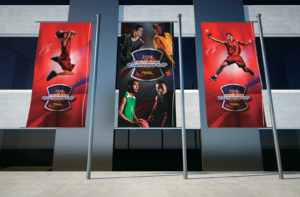
Digital printing on fabrics has revolutionized a number of markets: trade show exhibits, event marketing, home décor, activewear, retail branding, architectural signage, outdoor advertising and others.
“Demand for printed fabrics and textiles continues to grow, and the market requires greater variety of apparel and fabrics, limited and smaller production run quantities, and faster time from design concepts to [end products],” says Tim Check, product manager for professional imaging at Epson America Inc., Long Beach, Calif.
The technology and trends in fabric developments and printing equipment are leading the growth and expanding applications in this evolving industry. As the root of customer is custom, the adaptability
and versatility of digital printing makes design ever more responsive to creative demand.
In living color
Digital printer manufacturers are devoting more resources to boost performance in their products, and passing along those pressures to fabric suppliers in turn. “The printers used to process fabric are getting bigger, faster and putting out higher-quality graphics,” says Keith Sawyer, eastern regional director of printing and specialty fabrics for Dazian Creative Fabric Environments, South Hackensack, N.J.
Aberdeen Fabrics Inc., a mill in Aberdeen, N.C., makes polyester-based products for dye sublimation, latex and UV printers. Of the three technologies, “Dye sub is the best,” says Ken Bach, business development director for Aberdeen. “It has a much better color gamut, plus it is more permanent.”
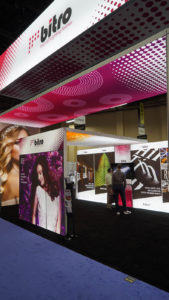
Lily Hunter, product manager, textiles and consumables, for equipment supplier Roland DGA Corp., Irvine, Calif., says that dye sublimation is the company’s biggest growth area within the fabric printing arena. “With advancements in polyester and athletic apparel, the popularity of dye sublimation has grown as well,” she says. “We’re seeing constantly increasing demand for sublimated trade show soft signage, retail soft signage and athletic apparel.” Hunter also reports brisk sales for Roland’s Texart™ dye-sublimation printers, and expects demand to continue to increase over the coming years.
Wide-format printing manufacturers are staying ahead of the curve. In 2013, Epson America introduced the SureColor® F-Series for dye-sublimation transfer printing. The printers, designed to require minimal maintenance, come in three different models: 44-inch Epson SureColor F6200, featuring a built-in cutter; 64-inch SureColor F7200, which offers automated take-up print roll system for long length prints and unattended printing; and 64-inch SureColor F9200, recommended for production printing because it features a dual-print head array and holds up to 12 liters of ink.
Mimaki USA Inc. has expanded its transfer sublimation offerings with the TS500P-3200. With the ability to print up to 129.5 inches wide, the model was developed for production transfer runs “to create extra-wide textile applications such as home furnishings, hospitality fabrics and soft signage,” says Ken VanHorn, vice president of marketing and operations.
The printer also includes a high-gap printhead unaffected by cockling, a common occurrence when using thin transfer papers. Twelve printheads deliver speeds of up to 1,937 square feet per hour in four-color mode.
Slated for release this summer, the Mimaki TX300P-1800 printer is suitable for users creating samples or short-run pieces. The model directly prints on thick or thin textiles, as well as on woven patterns or raised fiber surfaces, while maintaining accurate ink droplet placement.
Although dye sublimation dominates the market share in fabric printing, manufacturers are still making strides in solvent, latex and UV technology. Dazian Fabrics, for one, reports a demand for coated fabrics to accept more ink types.
Roland DGA has responded to that demand with its new TrueVIS™ VG series, which includes 64-inch VG-640 and 54-inch VG-540 models. These eco-solvent printers with integrated cutters handle coated fabrics for applications such as wallcoverings and soft signage using four newly developed printheads. Built-in Bluetooth® functionality allows users to control the printer remotely using a smartphone or tablet.
On exhibition: backlighting
Because of dye sublimation’s stronghold, fabric manufacturers are refining their offerings and developing new materials for a wide range of markets. The trade show sector was an early adopter of digital textile printing—dye sublimation in particular—and remains a top revenue generator for the industry. “The trade show market saw the benefits of it from day one because fabric made it much cheaper and easier to set up your booth,” says Bach.
More recently, trade show exhibit designers have embraced silicone edge graphics (SEG) as an eye-catching technique for displaying printed fabrics. The same goes for the retail industry. SEG features a printed fabric finished with a silicone strip that inserts into a recessed-groove frame.
“SEG is becoming a major player because of its clean look, wow factor and ease of installation,” says Sharon Roland, advertising and public relations manager for Fisher Textiles in Indian Trail, N.C. (For more information, read “A sharper image.”)
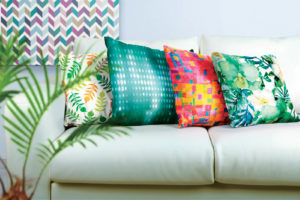
Backlit fabrics go hand-in-hand with SEG systems. In fact, Roland calls backlit fabrics “one of the hottest trends in our industry. Nothing else can compete with the pop of fabric graphics when lit from behind.”

Fabric manufacturers are developing products to meet the demand. Fisher Textiles recently released GF 6732 Apollo®, designed for backlit prints requiring the brightest white possible. Compatible with dye-sub technology, Apollo utilizes a diffuser fabric to enhance the print and prevent hot spots. The flame-retardant fabric is stocked at 120 inches wide and weighs 3.2 ounces.
Fisher’s wrinkle-resistant DD 6788 MoJo® fabric works with dye-sub, UV and latex printing. Like Apollo, it’s flame-retardant and offered at 120 inches wide, but is heavier at 5.3 ounces. Its slight stretch provides a tight fit in SEG systems.
“MoJo has been specially engineered for light dispersion and presents an extremely vivid print that is amplified when backlit,” Roland says.
Dazian Fabrics is also capitalizing on the popularity of backlit fabric. “Our Cha-Cha product for backlit graphic light boxes has really been a hit, especially with dye-sub, UV and latex printers,” says Laura Wilson, west coast print media specialist.
New VorTex™ Backlit Precision T130 from Ultraflex Systems Inc., Randolph, N.J., was engineered with a unique coating that prevents color distortion due to cracking if the fabric is creased. “The print surface allows for rich and uniform saturation resulting in vivid backlit graphics through dye-sublimation transfer,” says marketing manager Kylie Schleicher.
Activewear anywhere
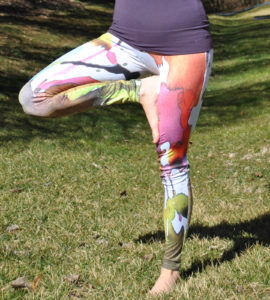
Another end product making waves—sometimes literally—is activewear. “Active lifestyle apparel continues to grow in popularity and includes attire for yoga, swim and surf,” says Ken Siecinski, program manager for the activewear/outerwear division, Top Value Fabrics, Carmel, Ind. “This clothing is designed to be worn from the wearer’s activity straight into their daily routine as casual, comfortable apparel.”
Top Value Fabrics produces a variety of knit, stretch, tricot and woven fabrics for activewear engineered exclusively for dye-sub transfer printing. The company’s Full Dull Polyester with Spandex for leggings, yoga and compression tops and bottoms reduces see-through and offers better resistance to pilling. Heavy Polyester Spandex targets wrestling and cyclewear, while new Heavy Eyelet Mesh goes after wearers in athletics such as football and lacrosse. Other new activewear products suitable for dye sublimation printing include Pin Dot Fleece and Cordura® HP fabric for high abrasion resistance.
Fisher Textiles recently introduced ET 3000 Yoga for customized yoga pants, made with Repreve® yarns produced from recycled plastic bottles. The fabric features a moisture management system that allows perspiration to move away from the body.
Application on tap
One common theme seems to prevail among manufacturers and distributors of fabrics and the associated print technologies: If you can think it, you can print it.
“Interior décor is an area that offers great opportunities,” says Mimaki’s VanHorn. Environmental graphics for office lobbies, hotel rooms and medical treatment areas such as those of dentists and therapists “are desirable because of their softer feel that imparts a feeling of homeyness.”
Interior designers and consumers are bringing printed fabrics into the home front as well, with customized items including wallcoverings, window treatments, carpeting and mats, upholstery and bedding. The desire for personalization also extends to apparel for end uses such as limited-edition designer fashion, swimwear, yoga clothing, hats, footwear and sports jerseys. Accessories for infants and children—bibs, blankets and onesies, to name a few—are also on the upswing.
For Aurora Specialty Textiles Group Inc., Yorkville, Ill., this increasing demand for customization is driving growth, particularly with wallcoverings. “Our canvas side of the business is expanding because of the wallcovering category,” says Mark Shaneyfelt, director of sales and marketing for print media. “There are huge opportunities for new finishes and textures.”
The same goes for backlit fabrics. “We see a lot of development work happening to meet specific applications for customers, where they want to shine LED lights directly through the fabric but don’t want pinholes, or they want to stretch a fabric to a unique frame,” Shaneyfelt says.
He notes that the retail industry also represents a strong growth market, describing a major retailer that increasingly is transitioning its in-store display and signage to fabric.
“They feel more pressured than ever to create a powerful retail message and experience for customers in their brick-and-mortar stores, because people have an option of buying online,” Shaneyfelt says. “The overall appearance and prestige that you accomplish with the fabric far exceeds plastics, papers and vinyls.”
With advances in fabric versatility and digital printing technologies that are increasingly economical and user-friendly, the demand for custom graphics will continue to expand, in both residential and commercial applications.
Holly O’Dell is a freelance writer based in Joshua Tree, Calif.


Is sustainability still a priority?
On the fabric side
Discussions about sustainability are ubiquitous in any business, but the digital fabric printing industry seems to be split on how important an issue it is. Going green “has not been an area that most companies want to take on directly,” says Ken Bach, business development director at Aberdeen Fabrics Inc., Aberdeen, N.C. He cites the recession of 2008 as a major roadblock.
The prior year, sustainable fabrics were on the upswing. But when the Great Recession hit, “folks hunkered down and wanted the cheapest item; it’s prevented the green aspect of the industry from popping up,” Bach says. “And it really hasn’t picked up since.”
Laura Wilson, west coast print media specialist for Dazian Creative Fabric Environments, agrees. “As the print fabric market has matured, many customers seem to have moved away from focusing on sustainability,” she says. “We offer green options, but customers are more focused on flame-retardance and other characteristics required by applications in certain markets, such as the trade show industry.”
For equipment manufacturers
On the printing side, equipment manufacturers have focused many of their eco-friendly efforts on inks. Roland DGA Corp. and Mimaki USA Inc. produce inks that have received GREENGUARD Gold certification, “which assures users that they meet UL Labs’ most rigorous standards for low VOC emissions into indoor air,” says Lily Hunter, product manager, textiles and consumables, for Roland DGA.
Roland and Mimaki, as well as Epson America Inc., also produce inks and printing processes that meet the OEKO-TEX® Standard 100, Class 1 certification. “The OEKO-TEX criteria catalogue provides manufacturers in the textile and clothing industry with a scientifically based standard benchmark for the evaluation of potentially harmful substances in textiles,” says Ken VanHorn, vice president of marketing and operations for Mimaki USA.
What do customers want?
Consistency
“Customers look for the same quality of product from order to order,” says Kylie Schleicher, marketing manager of Ultraflex Systems Inc. “Some customers who do not like to inventory many different types of products look for fabrics that can be used for multiple applications.”
Wrinkle resistance
“Due to the nature of fabric usage, users want to be able to fold their prints for quick shipping,” says Sharon Roland, advertising and public relations manager with Fisher Textiles. “It is important that fabrics won’t hold any wrinkles during install.”
Variety
End product manufacturers are actively seeking out more options to offer their customers. “They are trying to set themselves apart with their design capabilities, and offering a wide range of fabrics along with various colored options is a bonus for their business,” says Keith Sawyer, Dazian’s eastern regional director of printing and specialty fabrics.
Low costs
As fabric product manufacturers face more pressure from their customers, “they’re looking for ways to keep the cost low,” says Ken Bach, business development director for Aberdeen Fabrics.